 May 13 had perfect weather for Youth Gut Together (YGT) space travel. Exploring space reminds us in many ways of the science of the human gut. Both are dark, mysterious and prone to potential hazards. However, as we learn new ways to investigate and make new discoveries, there are wondrous possibilities we are just beginning to imagine. So whether you explored the IBD labs on the Enterprise Tour or visited Galactic Genomes, we hope you learned more about our guts and what the CHEO IBD Centre team and our IBD scientist colleagues at uOttawa are doing to try to preserve human health and think about what could be next.
Interesting facts we shared at the event
Galactic Genomes
A critical part of IBD research is finding associations between the microbes in a person’s gut and their disease. Based on the presence of good and bad microbes in a microbiome, we are learning how to treat each patient better. While DNA reading technologies enable us to profile ALMOST all the microbes in the gut, some microbes are missing and are waiting to be discovered. "Galactic Genomes" demonstrated how DNA is decoded by sequencing technologies and how newly discovered microbes get added to databases.
DNA is out of this world!
At the DNA extraction station, participants could isolate the DNA from a “space banana” (Bananakin skywalkerus) or “space strawberry” (Strawbacca wookeii). After extracting it from the fruit, the DNA could be seen and touched! DNA is an important part of our IBD research because we use it to identify which microbes are present in different people. The DNA also helps us figure out what the microbes are doing in our bodies. Using DNA-based technology, we are learning more and more about the importance of gut microbes in IBD.
Starch Wars
The microbes in your gut have their own preference for certain types of resistant starch, which can impact their growth and activity. Some types of resistant starch can be more helpful than others depending on the microbes that are present. This station demonstrated how different microbes prefer one resistant starch over the other.
Astoolnauts on the go
In order to grow the microbes in a stool sample for IBD research, we first must process the stool to remove food debris and fibers. This processing must be done in a specific environment (the anaerobic chamber) to keep the microbes in the stool sample alive and happy in the low oxygen environment they prefer. Once the microbes have been isolated, we can see how they grow in the lab and predict how they would grow inside your own gut.
Revealing our inner aliens
Gut microbes differ in their ability to grow using different nutrients (sugar/protein/sugar-alcohols) and they may use these nutrients in unexpected ways. By growing microbes in the lab using different growth conditions, we can see which microbes are present and how they grow in the presence of different nutrients. This will help us determine the key nutrients that are needed by the good microbes in your gut.
Videos
Photos
 Genome Canada recently awarded Dr. David Mack, Dr. Alain Stintzi along with a team of researchers at the University of Ottawa and CHEO $9.1 million to help crack the mystery of the intestinal microbiome in Crohn's disease and ulcerative colitis (Inflammatory Bowel Disease - IBD) and find better treatments. With these funds, the team expects to make a significant difference in the lives of children like Sebastien.
 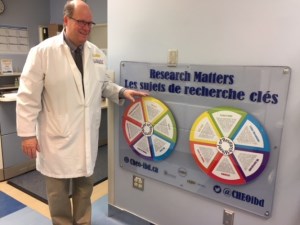 The “Wheels of Research” is an interactive tool that engages families in Research Projects. Made possible by the generous funding and resources of the IBD Foundation, the “Wheels” are spinning with new ideas, research overviews and the opportunity for discussion. Placed in the CHEO IBD Centre beside a wall of published articles already produced from research that our families have participated in, families are encouraged to ask about research and have opportunity to be involved.
 The book "Your Child with Inflammatory Bowel Disease" is an educational resource for parents of children and adolescents who have been diagnosed with Crohn's disease or ulcerative colitis. It was written by expert specialists in pediatric IBD who are members of the North American Society for Pediatric Gastroenterology, Hepatology, and Nutrition (NASPGHAN). Dr. Mack, Director of the CHEO IBD Centre, is a contributing author to this book. It is designed to help families understand what is happening or might happen to their child when he or she has been diagnosed with this chronic intestinal condition. The family of every child diagnosed with IBD at the CHEO IBD Centre is given a copy of this book to take home thanks to a generous donation and the continued support by the IBD Foundation.
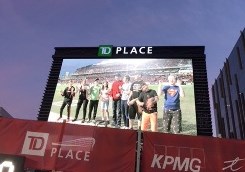 RedBlacks President Jeff Hunt and the IBD Foundation hosted the