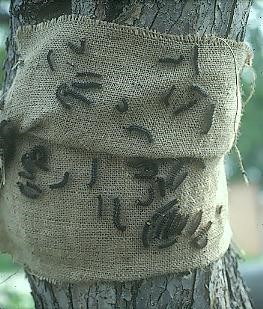
Spongy moth life cycle
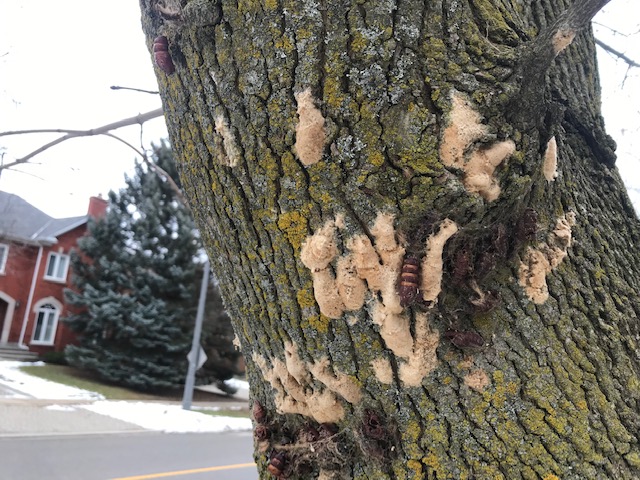
The spongy moth has four distinct developmental stages in its life cycle similar to other butterflies and moths.
- Egg (Late August to early May)
- Dormant stage (easiest to manage)
- Egg masses range in size from 2-8cm long and can contain between 100-1000 eggs
- Egg masses are usually oval shaped and beige/light brown in colour
- Often found on tree trunks and the underside of larger branches
- Caterpillar (Early May to mid-July)
- Tree damaging stage
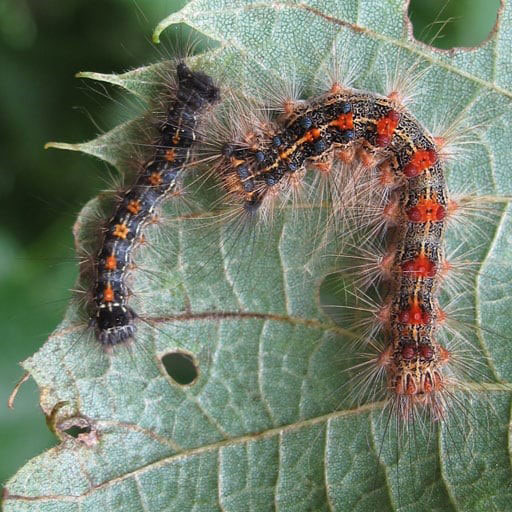
- Newly hatched caterpillars are about half a centimetre long and dark in colour. As they grow, they change colour becoming dark coloured and hairy with a double row of five pairs of blue spots followed by a double row of six pairs of red spots, down the back
- Caterpillars can be found feeding on the leaves of trees since this is their main food source
 Cocoon (Mid July to early August)
- Stage lasts for 10 to 14 days
- Once the adult moth emerges, it leaves the empty cocoon behind which can be seen on infested trees
- Moth (Early to late August)
- Stage lasts 10 days
- An adult spongy moth’s only function is to reproduce and not eat anything, unlike other moth and butterfly species
- Female is larger, white and cannot fly
- Male is smaller, brown and is attracted to pheromones produced by female moths
What does a spongy moth infestation look like?
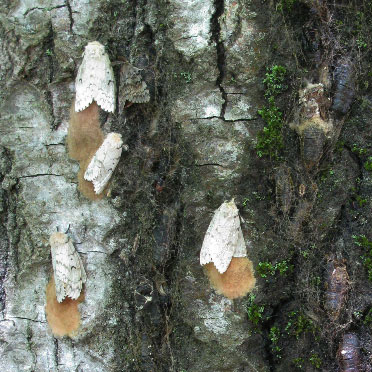
- From late August to early May, spongy, light-brown or beige egg masses can be observed on the trunks and branches of infected trees.
- From early May to mid-July, once the eggs have hatched, caterpillars chew holes in or devour entire leaves. During severe outbreaks, trees and shrubs have significant leaf canopy loss. Healthy trees can regrow their canopy as the season progresses.